 Photo by Ann H from Pexels
Arthur Weasley had one of the best warnings for anyone building with AI today.
In Harry Potter and the Chamber of Secrets, right after finding out that little Ginny Weasley had been pouring her “secrets” into Tom Riddle’s diary, he says:
Never trust anything that can think for itself if you cannot see where it keeps its brain.
The important part of that quote, at least for me, is not “never trust”.
It is “if you can’t see where it keeps its brain”. That distinction is important.
It came back to me last night in a completely different context. I have been building a small personal bot called CurioBot.
Not to manage my calendar. Not to optimise every hour of my day. Not to become an AI best friend.
More like a consistency buddy.
I was curious about whether AI could help with the more personal, messier side of productivity. Not the perfectly defined task, but the human problem behind the task.
Consistency. Memory. Attention. Follow-through. Reflection.
To pick up the things that keep getting forgotten or deprioritised: a message I meant to reply to but left the “draft” in my head, a task I meant to follow up on, an idea I wanted to record somewhere, an app I started with loads of energy and then avoided, or a reflection that felt important at midnight and vanished by morning.
So CurioBot became an experiment in building a personal system around those gaps.
I wanted it to send me small nudges, to check in with me, to understand my avoidance patterns and to track intentions, all without making my life revolve around Telegram, which was one of my biggest avoidance loops.
At first, the exciting part was simply getting the bot to work. You create a small workflow, and suddenly there is a system that seems to support you.
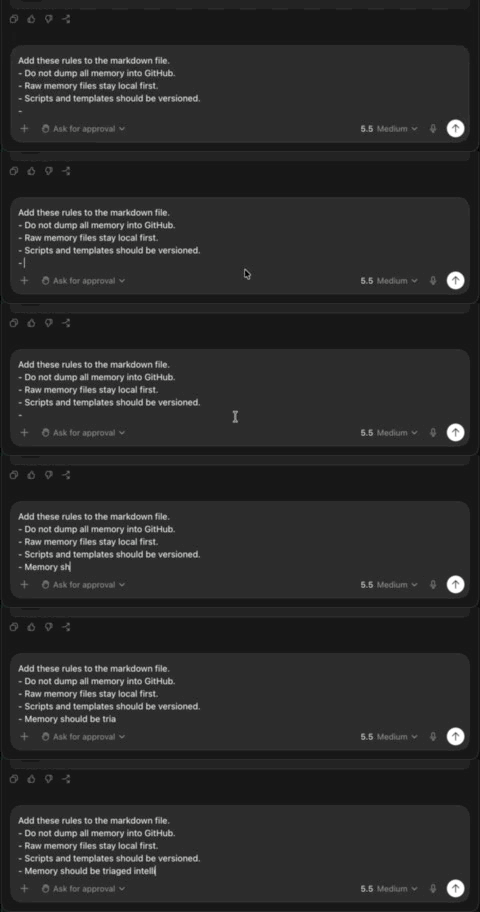
The real questions began when I wondered where its “brain” lived. What memory is it keeping? Which prompt is shaping its behaviour? Which config controls what it can do? Which tokens give it access to which systems? What can it read or change?
And when it behaves in a way I do not want, can I inspect it, correct it, and change the rule for next time?
That was when Arthur Weasley’s warning suddenly felt less like a magical-world warning and more like an engineering principle.
With AI agents, the “brain” is not one single magical object. It is scattered across prompts, memory files, configuration, tool permissions, access tokens, logs, routing rules, the surrounding workflow, and sometimes even the assumptions you forgot you gave it three weeks ago.
CurioBot is not Tom Riddle’s diary. But the analogy still works, because it is about not giving trust to something whose behaviour you cannot see, explain, constrain, or correct.
A system can be clever and still misunderstand. It can remember something correctly and use it in the wrong context, or confidently follow an instruction that made sense yesterday but no longer makes sense today.
That is why visibility matters.
Not just “what did it answer?”, but what shaped that answer, what it had access to, what action it took, and whether I can trace, undo, or correct it.
The most important thing about working with AI agents is not just learning how to use them, but learning how to build around them responsibly: designing boundaries, keeping permissions clear, making memory inspectable, deciding where approval is required, and leaving enough footprints to trace what happened later.
I should not have to enter the Chamber of Secrets just to understand where the brain is kept.
When an AI system can remember, summarise, nudge, route, suggest, or act, developer responsibility changes.
The job is no longer only to build a system that works. It is also to build one that is trustable.
To know where the brain is. And to remain accountable for what it does.
Arthur Weasley was right.