Years ago, I ran into an early-day video from Ryder Caroll, the founder of the Bullet Journal Method.
At that point in time, I was trying to find structure and purpose in my everyday life. That was the goal. But I was struggling to organise my thoughts, and when I found this video, I knew this was it.
I was hooked from the start.
When I had tried everything
I wanted to write a diary as a child. My expectation was to note down what time I woke up, what I ate that day, who I met, and what time I went to bed. I didn’t have that much going on in my life to record minute details, and spending half an hour every day on this wasn’t a very meaningful prospect.
As an adult, I tried planners. Big planners. Small planners. There was always a page that was empty or one that was overfilled. There were things that forgotten to be written down. It felt like too much, and at the same time, not useful enough.
I enjoyed writing a lot when things happened. When life felt very good, or completely overwhelming. I wanted to record moments and feelings that photographs couldn’t capture. On sheets of paper. There was no rule. No schedule. No routine. I wrote when I felt the need to put my thoughts down on paper.
When I discovered The Bullet Journal Method
So when I first came across the BuJo Method, it was the simplicity that completely took me in.
My very first BuJo was a freebie notebook from some event. It had a lot of distracting advertisements but I didn’t care.
There wasn’t really much to do. You just jotted down some general points. And that’s it. You didn’t spend much time on it. You didn’t put any effort beyond the short bullets. All it took was something readily available, the notebook that was right next to me and a regular ballpoint pen.
I finished that notebook over time.
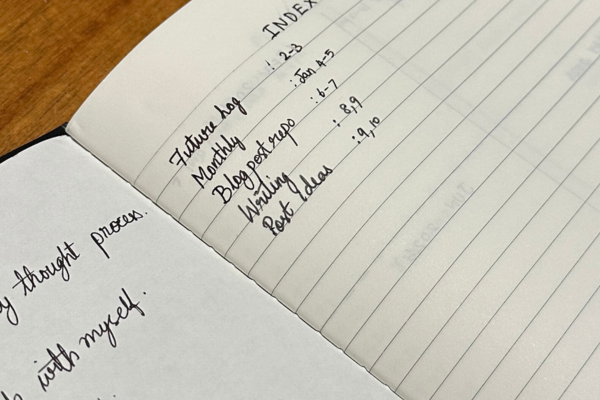
Easy to find indices.
Clean, easy to setup future logs.
No non-sense daily bullet points - a to-do list that actually got things done.
Brain Dump pages to clarify thoughts.
Things were tracked easily, efficiently; clear thoughts translated to action points.
… It was a habit that completely transformed me.
When I tried to improve what was already working
After successfully sticking with pen and paper bullet journalling for a while, I realised I didn’t want to carry the heavy notebook around wherever I went.
I had identified a problem. As someone wired to solve problems, I tried to modify the method with various tools.
I experimented with different systems. A smaller notebook to record ideas on the go. Fancy to-do apps. Apple Notes with templates. OneNote. Erasable notebooks. Scannable notebooks. Even Apple Reminders, an app I totally rethought and repurposed.
Each time, I found myself spending far more time playing with the tool than actually journalling. The actual solution was suprising. I didn’t need to have a leather bound notebook. All I needed was an 80 page notebook from the stationary section.
The same thing happened when I looked at the pretty BuJos shared on YouTube. So many colors. Templates. Perfect monthly, weekly, daily spreads. All of them typically taking a long time to setup. Most of the time, it felt like people were showcasing their own sketchbook-y idea of a Bullet Journal, but had forgotten the core idea of the original method. Simplicity. Sustainability.
When I learnt what was important
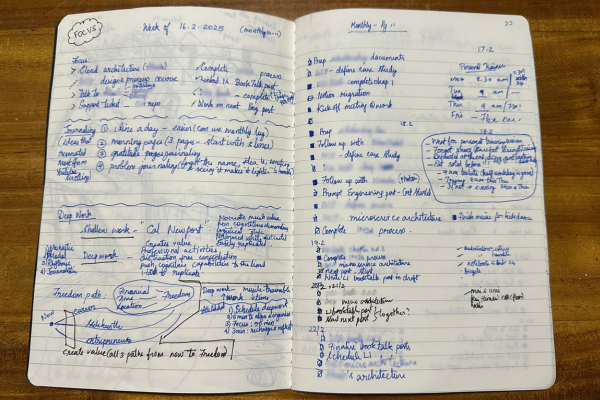 A weekly spread - looking messy, but it captured one of my busiest & productive weeks
This experience has taught me two important things:
- Not everything has to be improved, especially when it is already working.
- It doesn’t need to look perfect. Sometimes, just getting the job done in the most repeatable way is better.
In the end, I chose what works best. Just a notebook. Just a pen.